|
|
|
|
Staghorn Ferns at a Glance
|
|
Staghorn ferns are members of
the Polypodiaceae plant family, and belong to the genus Platycerium. Eighteen
species are presently recognized along with many varieties and Staghorn ferns are valued for
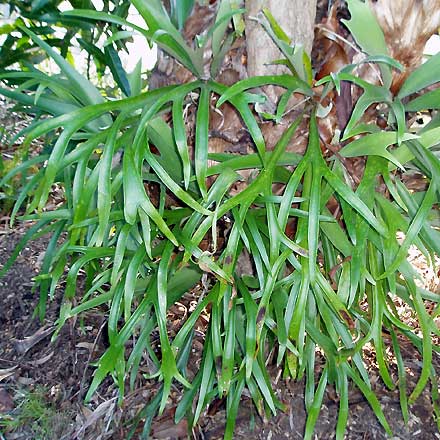
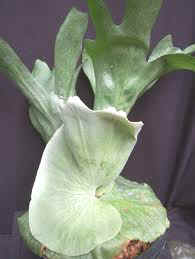
their highly variable and unusual growth habits. The plant
|
For additional pictures of Staghorns , click on the underlined links below.Most species of Staghorn ferns grow readily in
Florida although much depends on the |
| P. alcicorne - P. vassei |
Easy-to-grow species with upright fertile fronds, dark green. Basal fronds turn brown naturally. Pups well. Semi-hardy to 40°F (4.4°C). Native to Madagascar and East Africa. |
| P. andinum | Moderately
difficult. This dry forest species needs good ventilation, and drying between watering. Fronds covered with dense silvery hairs. Pups well. Only Platycerium native to South America, specifically in the mountains of Bolivia and Peru. Temperatures between 70-80°F (21.1-26.6°C), low of 60°F (15.5°C). Requires low light. |
| P. bifurcatum | The
most common species in cultivation and also the easiest to grow. Produces large numbers of "pups," eventually forming a very large plant. Dark green color.Hardy to temperatures of 25-30°F (1.1°C) for short periods. Many varieties are available. Native to Australia and New Guinea. |
| P. elephantotis (P. angolense) | Moderately difficult. Thrives in warm temperatures of 80-90°F (26.6-32.2°C), low of 60°F (15.5°C). Produces large unbranched foliar fronds, dark green. Basal fronds brown in the winter. Large fern. Native to dry forests of tropical Africa. |
| P. grande | Difficult to grow. Likes high humidity but is easily over-watered. Young plants produce only basal fronds. Foliar fronds reclining, light green in color. Does not pup. Tender below 60°F (15.5°C). A large fern, prized by collectors. Native to Philippines. |
| P. hillii | Easy to grow with semi-erect dark green foliar fronds. Produces pups. Semi-hardy to 40°F (4.4°C). Several varieties are available. Native to Australia and New Guinea. |
| P. madagascariense | Interesting,
small Platycerium, from Madagascar. It is essentially a twig epiphyte, and
is inhabited by ants, which live in the gaps created by the waffled shield
fronds. |
| P. ridleyi | One
of the most striking and beautiful Platycerium. It is difficult to grow. This
species
grows very high in trees. Subject to rots and other diseases, and a
favorite of many plant eating pests. One problem is that this is a solitary
species. This means that, if an insect eats the bud, the plant will die. The veins are raised. Ants in habitat inhabit this species, and this means it likes good fertility and the substrate should be somewhat acidic. |
| P. stemaria | More difficult to grow, requiring temperatures of 80°F (26.6°C) and not below 50°F (10°C). Needs high humidity and frequent watering. Semi-erect, large foliar fronds with a silvery case when young. Pups well. Large plant native to tropical Africa |
| P. superbum | Difficult to grow. Very similar in appearance to P. grande when young. Easily over-watered. Large reclining foliar fronds light green in color. Does not pup. Hardy to 30°F (1.1°C) for short periods, although prolonged cold temperatures not tolerated. Prized by collectors. Native to Australia. |
| P. veitchii | A common and easy-to-grow species with erect, silvery foliar fronds. Produces pups. Semi-hardy to temperatures of 25-30°F (1.1°C) and tolerant of light frost. A semi-desert species native to Australia that requires a lot of light. |
| P. wandae | Difficult to grow species. High humidity, easily over-watered. Temperatures between 80-90°F (26.6-32.2°C), lows of 60°F (15.5°C). Possibly largest Platycerium. Native to New Guinea. |
|
MountingBecause of their relatively large size,
staghorn ferns are rarely grown in pots except when produced as small specimens
for sale at nurseries. Their natural, epiphytic growth habit makes them well
suited for mounting on slabs of wood, tree fern fiber or wire baskets. To mount
a WateringIn general, allow the medium to dry completely
between watering. This may be difficult to FertilizationA water-soluble fertilizer with a 1:1:1 ratio
(i.e., 10-10-10, 20-20-20) is recommended. Staghorn ferns can be fertilized
monthly during the warm, growing months of the year and every other month when
growth slows down. Frequent fertilization is only necessary when you want LightMost staghorn ferns thrive best under
partially shaded conditions. The dappled light of a shade tree or indirect light
on an outdoor porch is ideal. This is the equivalent of 600-2000 foot candles.
Very low light conditions produce slow growing ferns that are likely to develop
disease and TemperatureMost staghorn ferns are considered tender or semi-tender to cold and will not tolerate cold temperatures. There are exceptions, such as P. bifurcatum and P. veitchii, which can withstand temperatures as low as 25°F (1.1°C). South Florida growers will have relatively few occasions when cold protection is needed. Most staghorns grown outdoors are usually in protected, naturally warmer microclimates such as under tree canopy. However, central and north Florida growers should be prepared to bring ferns into a heated garage, greenhouse or home when extremely cold temperatures are predicted. PropagationPropagating staghorn ferns from spores is slow and difficult and is not practical for most gardeners. Pups (with their root systems) can be carefully removed from large ferns and re-established. Wrap the roots in damp sphagnum and then tie the root ball to a mount. Eventually the sterile frond will expand and grip the mount. ProblemsStaghorn ferns are fairly pest free. When kept
too wet, they are susceptible to a disease The insect pests to watch for are mealy bugs
and scales. Insecticides are effective against |
|
|
|
|
|